
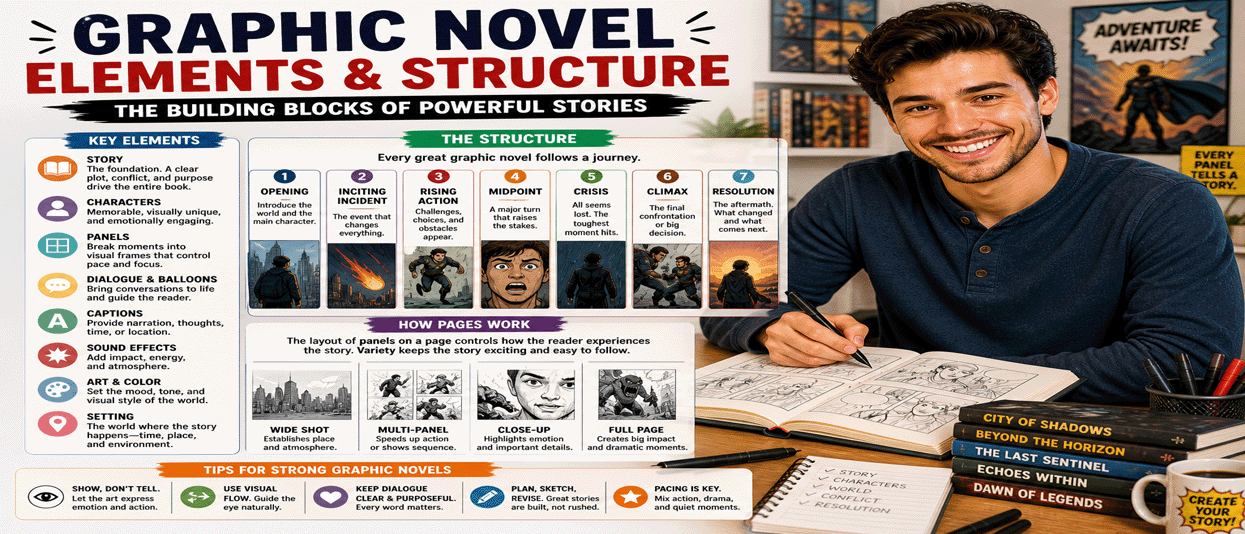
A graphic novel is more than a book with pictures. It is a complete storytelling system where art, words, layout, pacing, and design work together to create an emotional reading experience.
Understanding the basic graphic novel elements and structure can help writers, artists, teachers, students, and new creators build stronger stories.
What Is a Graphic Novel?
A graphic novel is a longer visual story told through sequential art. It uses panels, dialogue, captions, character design, setting, and page layout to move the story forward.
Unlike a single comic issue, a graphic novel often feels like a complete book with a beginning, middle, and end.
Core Elements of a Graphic Novel
1. Story
The story is the foundation. A strong graphic novel needs a clear main character, a goal, conflict, emotional stakes, and a satisfying resolution.
2. Characters
Characters should be visually memorable and emotionally interesting. Readers connect with what characters want, fear, hide, and fight for.
3. Panels
Panels are the boxes or spaces that contain each moment of the story. They control pacing, focus, action, and emotion.
4. Gutters
The gutter is the space between panels. This quiet space lets readers imagine what happens between one image and the next.
5. Speech Balloons
Speech balloons show spoken dialogue. Their placement should guide the reader naturally through the page.
6. Captions
Captions can show narration, time, location, inner thoughts, or story transitions.
7. Sound Effects
Sound effects such as “BOOM,” “CRACK,” or “WHISPER” add energy and atmosphere when used carefully.
8. Page Layout
Page layout determines how panels are arranged. Good layout makes the story easy to follow and visually exciting.
9. Art Style
The art style sets the tone. A horror graphic novel may use shadows and sharp lines, while a comedy may use bright colors and exaggerated expressions.
10. Color and Mood
Color helps create emotion. Warm colors can suggest energy, danger, or romance. Cool colors can suggest sadness, mystery, or calm.
Basic Graphic Novel Structure
1. Opening Scene
The opening scene introduces the world, tone, and main character. It should make readers curious enough to continue.
2. Inciting Incident
This is the event that changes the character’s normal life and begins the main story.
3. Rising Action
The character faces challenges, makes choices, meets allies or enemies, and moves deeper into conflict.
4. Midpoint
The midpoint is a major turning point where the story becomes more intense, personal, or dangerous.
5. Crisis
The crisis is the moment when everything seems lost. The character must face fear, failure, or a difficult truth.
6. Climax
The climax is the biggest conflict or most emotional moment of the story.
7. Resolution
The resolution shows what changed and gives the reader emotional closure.
How Graphic Novel Pages Are Built
Most graphic novel pages include several panels arranged in a readable order. The layout can be simple or dramatic depending on the scene.
- Wide panels: good for landscapes and establishing shots
- Small panels: good for fast action or quick reactions
- Full-page panels: good for major reveals or emotional impact
- Close-ups: good for facial expressions and tension
- Silent panels: good for mood, suspense, or reflection
Why Pacing Matters
Pacing controls how fast or slow the reader experiences the story. A page with many small panels feels fast. A page with one large image feels slower and more dramatic.
Good pacing helps action scenes feel exciting and emotional scenes feel meaningful.
Visual Storytelling Rules
- Show emotion through faces and body language.
- Use backgrounds to establish place and mood.
- Keep speech bubbles easy to read.
- Let artwork carry part of the story.
- Use page turns for surprises and reveals.
Graphic Novel Structure Template
- Chapter 1: Introduce hero, world, and problem.
- Chapter 2: Increase conflict and reveal stakes.
- Chapter 3: Add complications, allies, enemies, or secrets.
- Chapter 4: Force the hero into a major decision.
- Chapter 5: Build toward the final confrontation.
- Chapter 6: Deliver climax, resolution, and emotional payoff.
Common Mistakes to Avoid
- Too much text in each panel
- Confusing panel order
- Weak character motivation
- Pages with no visual variety
- Dialogue that explains what the art already shows
- No clear beginning, middle, or end
Final Thoughts
The best graphic novels combine strong writing with powerful visual storytelling. When story, characters, panels, captions, color, pacing, and structure work together, the result feels cinematic, emotional, and unforgettable.
Whether you are reading, teaching, or creating graphic novels, understanding these elements will help you appreciate how much craft goes into every page.
Graphic Novels Free Related Articles