
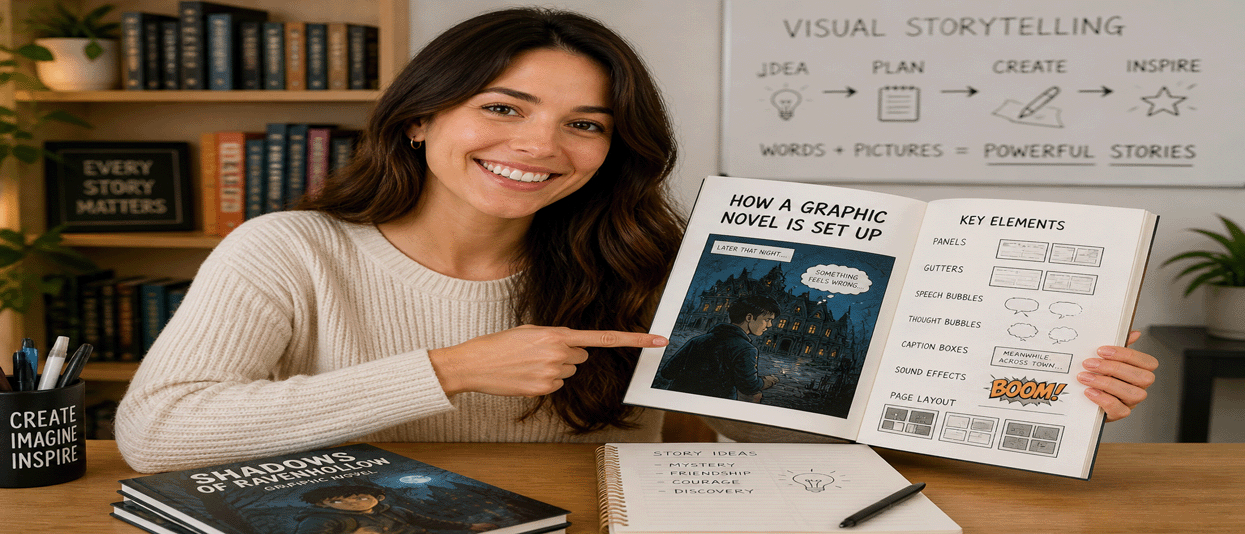
A graphic novel is set up like a visual storybook, using pictures and words together to guide readers from page to page. Instead of relying only on paragraphs, a graphic novel uses panels, speech bubbles, captions, page turns, character art, and scene design to tell the story.
Understanding how a graphic novel is set up can help readers, students, teachers, and new creators better understand the craft behind visual storytelling.
1. The Cover
The cover is the first thing readers see. It usually includes the title, artwork, author name, illustrator name, and mood of the story.
Example: A mystery graphic novel might show a dark mansion, a glowing window, and a character holding a flashlight.
2. The Opening Pages
The opening pages introduce the world, tone, and main character. A strong opening helps readers understand where they are and why the story matters.
Example: A boy walks through a rainy town and notices a strange missing-person poster.
3. Panels
Panels are the boxes or sections on each page. Each panel shows one moment in the story.
Small panels can make the story move quickly. Large panels slow the story down and create drama.
4. Gutters
The gutter is the blank space between panels. This space lets readers imagine what happens between one moment and the next.
Example: Panel 1 shows a door opening. Panel 2 shows bright light filling the room. The reader imagines the movement between both panels.
5. Speech Bubbles
Speech bubbles show what characters say. Their tails point toward the speaker.
Example: “I don’t think we should go inside.”
6. Thought Bubbles
Thought bubbles show what a character is thinking.
Example: “Something feels wrong…”
7. Caption Boxes
Caption boxes give narration, time, place, or extra story information.
Examples: “Later that night…” or “Meanwhile, across town…”
8. Sound Effects
Sound effects make action and atmosphere feel more exciting.
Examples: “BOOM!” “CREEEAK…” “THUD!”
9. Page Layout
Page layout controls how readers move through the story. A simple page may use four or six panels. A dramatic page may use one large image.
- Grid layout: neat and easy to follow
- Full-page panel: dramatic and emotional
- Split page: shows two scenes at once
- Close-up panel: focuses on emotion
10. Chapter Structure
Many graphic novels are divided into chapters. Each chapter usually contains a major scene, conflict, discovery, or turning point.
Simple chapter setup:
- Chapter 1: Introduce the character and world
- Chapter 2: Present the main problem
- Chapter 3: Increase conflict
- Chapter 4: Reveal a secret
- Chapter 5: Build toward the climax
- Chapter 6: Resolve the story
11. Story Flow
A graphic novel should guide the reader naturally from left to right and top to bottom. Speech bubbles, character movement, and panel placement should all help the reader know where to look next.
12. Ending Pages
The ending pages show how the conflict is resolved. They may include a final emotional moment, a lesson learned, or a cliffhanger for the next book.
Basic Graphic Novel Setup Example
- Cover: Title and main artwork
- Page 1: Opening scene
- Pages 2–5: Introduce character and setting
- Pages 6–10: Main problem begins
- Middle pages: Challenges, clues, action, and emotion
- Final pages: Climax and resolution
Final Thoughts
A graphic novel is set up using both story structure and visual design. Panels, gutters, speech bubbles, captions, sound effects, page layout, chapters, and artwork all work together to create a smooth reading experience.
Once you understand how a graphic novel is set up, it becomes much easier to read, teach, analyze, or create one yourself.
Graphic Novels Free Related Articles