
Graphic Novel Elements and Structure: A Beginner’s Guide
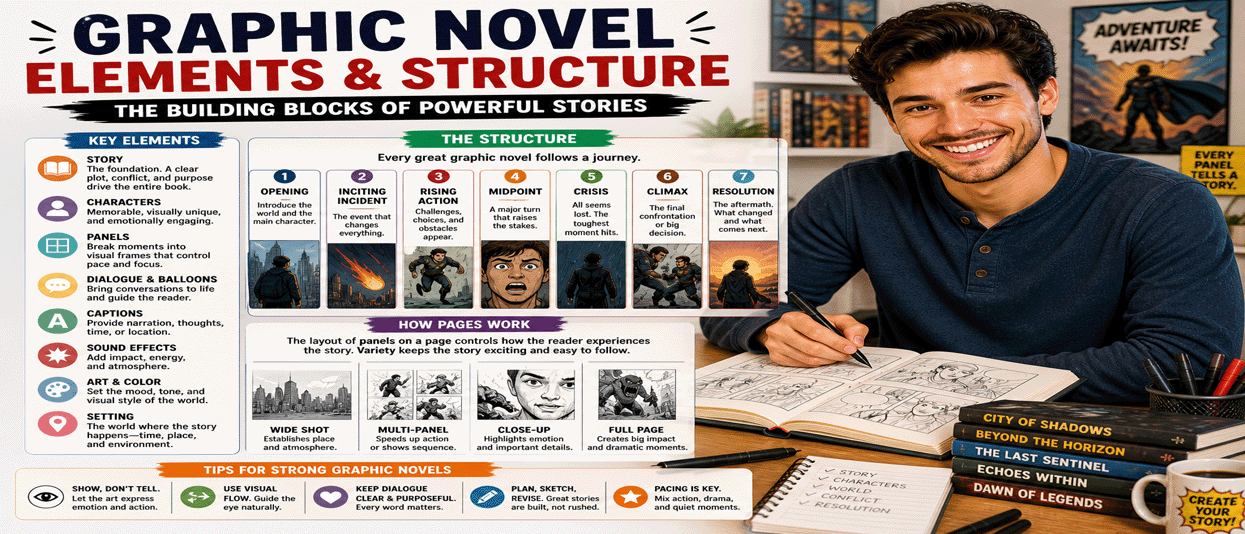
A graphic novel is more than a book with pictures. It is a complete storytelling system where art, words, layout, pacing, and design work together to create an emotional reading experience.
Understanding the basic graphic novel elements and structure can help writers, artists, teachers, students, and new creators build stronger stories.
What Is a Graphic Novel?
A graphic novel is a longer visual story told through sequential art. It uses panels, dialogue, captions, character design, setting, and page layout to move the story forward.
Unlike a single comic issue, a graphic novel often feels like a complete book with a beginning, middle, and end.
Core Elements of a Graphic Novel
1. Story
The story is the foundation. A strong graphic novel needs a clear main character, a goal, conflict, emotional stakes, and a satisfying resolution.
2. Characters
Characters should be visually memorable and emotionally interesting. Readers connect with what characters want, fear, hide, and fight for.
3. Panels
Panels are the boxes or spaces that contain each moment of the story. They control pacing, focus, action, and emotion.
4. Gutters
The gutter is the space between panels. This quiet space lets readers imagine what happens between one image and the next.
5. Speech Balloons
Speech balloons show spoken dialogue. Their placement should guide the reader naturally through the page.
6. Captions
Captions can show narration, time, location, inner thoughts, or story transitions.
7. Sound Effects
Sound effects such as “BOOM,” “CRACK,” or “WHISPER” add energy and atmosphere when used carefully.
8. Page Layout
Page layout determines how panels are arranged. Good layout makes the story easy to follow and visually exciting.
9. Art Style
The art style sets the tone. A horror graphic novel may use shadows and sharp lines, while a comedy may use bright colors and exaggerated expressions.
10. Color and Mood
Color helps create emotion. Warm colors can suggest energy, danger, or romance. Cool colors can suggest sadness, mystery, or calm.
Basic Graphic Novel Structure
1. Opening Scene
The opening scene introduces the world, tone, and main character. It should make readers curious enough to continue.
2. Inciting Incident
This is the event that changes the character’s normal life and begins the main story.
3. Rising Action
The character faces challenges, makes choices, meets allies or enemies, and moves deeper into conflict.
4. Midpoint
The midpoint is a major turning point where the story becomes more intense, personal, or dangerous.
5. Crisis
The crisis is the moment when everything seems lost. The character must face fear, failure, or a difficult truth.
6. Climax
The climax is the biggest conflict or most emotional moment of the story.
7. Resolution
The resolution shows what changed and gives the reader emotional closure.
How Graphic Novel Pages Are Built
Most graphic novel pages include several panels arranged in a readable order. The layout can be simple or dramatic depending on the scene.
- Wide panels: good for landscapes and establishing shots
- Small panels: good for fast action or quick reactions
- Full-page panels: good for major reveals or emotional impact
- Close-ups: good for facial expressions and tension
- Silent panels: good for mood, suspense, or reflection
Why Pacing Matters
Pacing controls how fast or slow the reader experiences the story. A page with many small panels feels fast. A page with one large image feels slower and more dramatic.
Good pacing helps action scenes feel exciting and emotional scenes feel meaningful.
Visual Storytelling Rules
- Show emotion through faces and body language.
- Use backgrounds to establish place and mood.
- Keep speech bubbles easy to read.
- Let artwork carry part of the story.
- Use page turns for surprises and reveals.
Graphic Novel Structure Template
- Chapter 1: Introduce hero, world, and problem.
- Chapter 2: Increase conflict and reveal stakes.
- Chapter 3: Add complications, allies, enemies, or secrets.
- Chapter 4: Force the hero into a major decision.
- Chapter 5: Build toward the final confrontation.
- Chapter 6: Deliver climax, resolution, and emotional payoff.
Common Mistakes to Avoid
- Too much text in each panel
- Confusing panel order
- Weak character motivation
- Pages with no visual variety
- Dialogue that explains what the art already shows
- No clear beginning, middle, or end
Final Thoughts
The best graphic novels combine strong writing with powerful visual storytelling. When story, characters, panels, captions, color, pacing, and structure work together, the result feels cinematic, emotional, and unforgettable.
Whether you are reading, teaching, or creating graphic novels, understanding these elements will help you appreciate how much craft goes into every page.
Graphic Novels Free Related Articles
Graphic Novel Techniques: How to Tell Better Stories With Art and Words
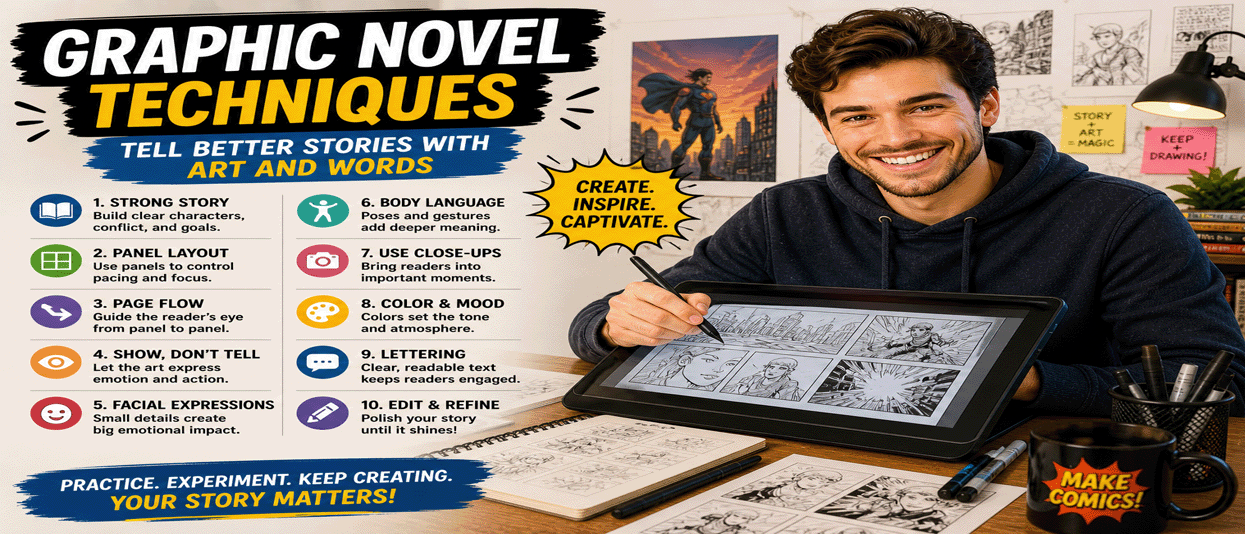
A great graphic novel is more than drawings and dialogue. It is a carefully designed reading experience where images, words, pacing, emotion, and page layout work together to tell a powerful story.
Whether you are creating your first comic or planning a full-length graphic novel, learning key graphic novel techniques can help your pages feel more professional, emotional, and easy to follow.
1. Start With a Strong Story Structure
Before drawing pages, build a clear story foundation. Your graphic novel should have a beginning, middle, and end. Readers need to understand who the main character is, what they want, what stands in their way, and why it matters.
- Introduce the main character quickly.
- Show the central problem early.
- Build tension through conflict.
- End scenes with curiosity or emotion.
- Give the story a satisfying resolution.
2. Use Panels to Control Pacing
Panels are one of the most important tools in graphic novel storytelling. Small panels can make a scene feel fast. Large panels slow the reader down and create dramatic impact.
For action scenes, use more panels with quick changes in movement. For emotional moments, use fewer panels and give important expressions more space.
3. Create Clear Page Flow
Readers should never feel lost on the page. Good page flow guides the eye naturally from one panel to the next.
- Keep panel order easy to follow.
- Use character movement to guide the eye.
- Place speech bubbles in reading order.
- Avoid cluttered layouts unless confusion is intentional.
4. Balance Words and Images
A graphic novel should not explain everything with text. Let the artwork carry emotion, setting, action, and body language whenever possible.
Use dialogue and captions only where they add meaning. If the image already shows sadness, fear, surprise, or danger, the words should deepen the moment—not repeat it.
5. Master Facial Expressions
Readers connect with characters through faces. A raised eyebrow, nervous smile, clenched jaw, or tearful stare can say more than a full paragraph.
Practice drawing emotional range. Your characters should look different when they are angry, afraid, embarrassed, hopeful, shocked, or relieved.
6. Use Body Language
Body language helps readers understand character emotions even before they read the dialogue.
- Crossed arms can show defensiveness.
- Slumped shoulders can show defeat.
- Leaning forward can show interest or aggression.
- Wide stance can show confidence.
- Hands covering the face can show fear or shame.
7. Design Strong Establishing Shots
An establishing shot shows readers where the scene takes place. It might show a city street, haunted mansion, spaceship hallway, classroom, forest, battlefield, or quiet bedroom.
Use establishing shots at the start of important scenes so readers feel grounded in the world.
8. Use Close-Ups for Emotional Impact
Close-ups are powerful because they pull the reader into a character’s feelings. Use close-ups for important reactions, shocking discoveries, emotional decisions, or silent moments.
A close-up of a trembling hand, a tear, a locked door, or a character’s eyes can create tension without needing many words.
9. Vary Your Camera Angles
Graphic novels borrow many techniques from film. Camera angles can change how readers feel about a scene.
- Low angle: makes a character look powerful or threatening.
- High angle: makes a character look vulnerable.
- Wide shot: shows setting and scale.
- Close-up: shows emotion.
- Over-the-shoulder shot: creates conversation depth.
10. Use Color to Create Mood
Color can change the emotional tone of a graphic novel. Warm colors can feel energetic, romantic, dangerous, or nostalgic. Cool colors can feel calm, lonely, mysterious, or sad.
Create a color palette for your story before you begin. Consistent colors help your graphic novel feel polished and intentional.
11. Make Lettering Easy to Read
Good lettering should feel invisible. Readers should understand the words without struggling.
- Use readable fonts.
- Keep speech bubbles clean.
- Do not overcrowd panels with text.
- Place bubbles in natural reading order.
- Use bold text sparingly for emphasis.
12. Use Sound Effects Wisely
Sound effects can make action scenes more exciting. Words like “BOOM,” “CRACK,” “WHAM,” or “DRIP” can become part of the artwork.
The style of the sound effect should match the mood. A horror drip should look different from a superhero explosion.
13. Create Memorable Page Turns
In printed or digital page-by-page formats, page turns are perfect for surprises. Place reveals, twists, monsters, transformations, or dramatic moments after a page turn for stronger impact.
14. Build Visual Themes
Visual themes help make your graphic novel feel deeper. Repeating symbols, colors, objects, or settings can add emotional meaning.
For example, a cracked mirror might represent identity. A red scarf might represent love or danger. A storm might appear whenever conflict rises.
15. Edit Ruthlessly
Strong graphic novels are clear and focused. After drafting, review every page and ask:
- Does this panel move the story forward?
- Is the emotion clear?
- Can the reader follow the action?
- Is there too much text?
- Can the artwork say more than the caption?
Final Thoughts
Graphic novel techniques help turn simple drawings into unforgettable stories. By mastering panel design, pacing, facial expressions, body language, color, lettering, and page flow, you can create pages that feel exciting, emotional, and professional.
The best graphic novels make readers forget they are looking at panels. They pull readers into a world, make them care about characters, and keep them turning pages.
Graphic Novels Free Related Articles
- Best Software to Create a Graphic Novel (Beginner to Pro Guide)
- Best Websites to Read Graphic Novels Free Online
- Graphic Novel Elements and Structure: A Beginner’s Guide
- Graphic Novel Techniques: How to Tell Better Stories With Art and Words
- Graphic Novel vs Comic Book vs Manga: What’s the Difference?
- Graphic Novel vs Comic: What Is the Difference?
- Graphic Novels and Anime: How Visual Storytelling Connects Two Powerful Art Forms
- How Is a Graphic Novel Set Up? A Beginner’s Guide to Format and Layout
- Parts of a Graphic Novel Worksheet: A Simple Guide for Students and Teachers
- Top 25 Free Graphic Novels You Can Read Right Now